

So recently I was exploring Shirudo (https://shirudo.dev/) which is basically an Open Source Linux runtime which allows AI agents to keep system secure without downtime.
What it does basically - It lets agents write dynamic eBPF controls to shield systems from exploits, giving defenders more time to test and roll out patches.
But I didn't have any idea what this eBPF was, so I researched on it, to know what it is and what it does in short. but after learning about it I got suprised and interested about it and what are the possibilities it can open. So Like me if u also didn't knew what eBPF was, here's what I understood.
What is eBPF ?
eBPF (extended Berkeley Packet Filter) is a technology that allows us to run sandboxed, custom programs inside the Linux kernel dynamically, without changing kernel source code or loading risky kernel modules.
To understand why this is a big deal, we first need to look at how Linux is divided and why modifying the kernel used to be so painful.
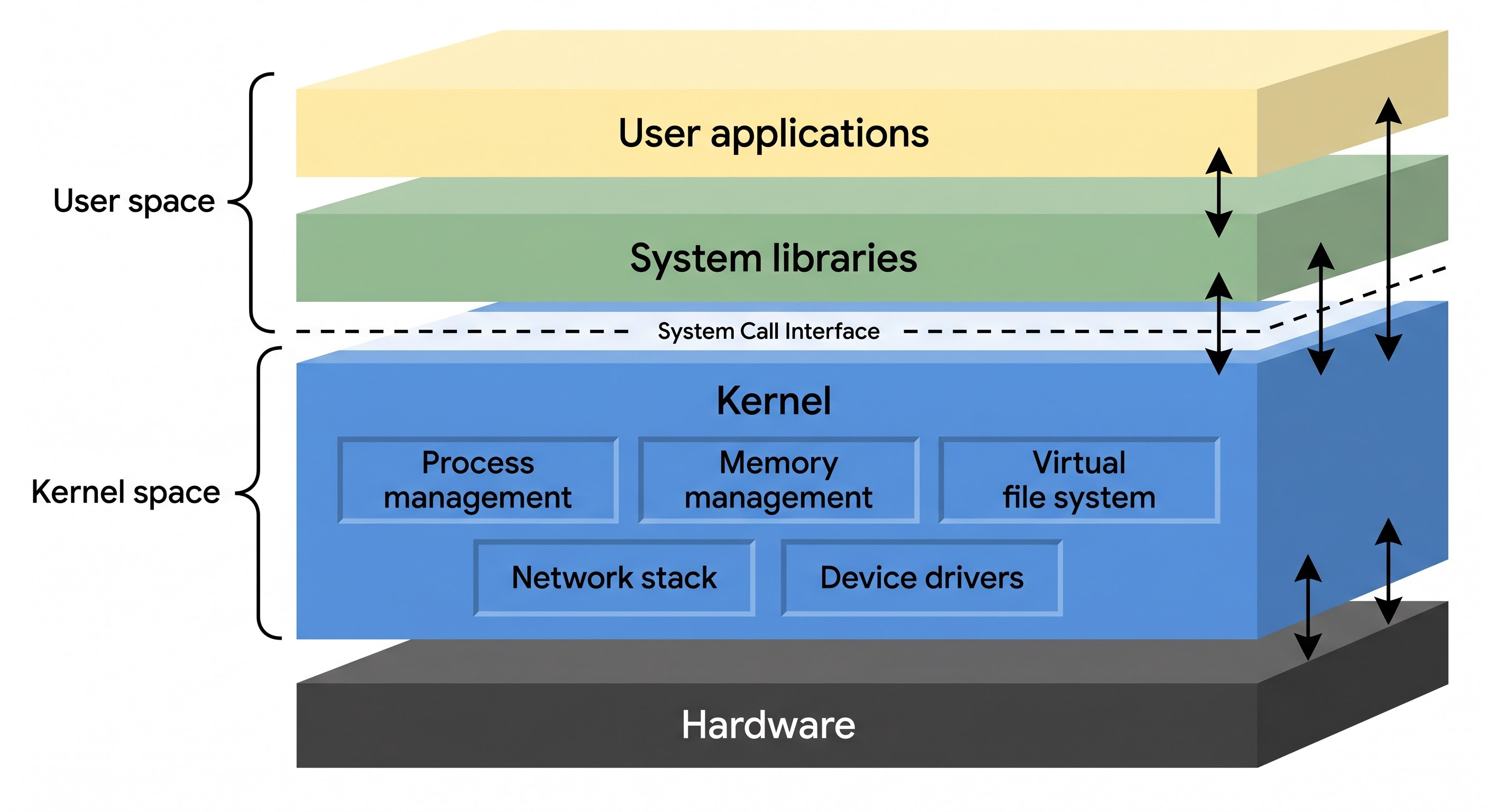
The Divide: User Space vs. Kernel Space
Every Linux system splits its memory and execution into two distinct privileges:
- User Space: Where our everyday applications run - web servers, databases, Python scripts, and CLI tools. Code here is isolated; if an application crashes, the rest of the system survives. To talk to hardware, read a file, or open a network socket, user-space programs must ask the kernel for permission via System Calls (syscalls).
- Kernel Space: The privileged core of the operating system. It manages CPU scheduling, memory, storage, and networking. Because it has unrestricted access to hardware, a single bug, infinite loop, or null-pointer dereference in kernel space brings down the entire machine with a Kernel Panic.
Earlier, if we wanted to add anything in kernel like deep observability, custom packet filtering, or security enforcement, we had only two choices:
- Modify the kernel source code directly and wait years for our changes to be reviewed, merged upstream, and adopted by enterprise Linux distributions.
- Write a Loadable Kernel Module (LKM), which runs with full kernel privileges meaning a single memory bug in our module could crash the whole server or introduce a severe privilege-escalation vulnerability.
eBPF solves this problem by giving us/developers a safe, fast, and dynamic way to extend kernel behavior on the fly.
How eBPF Works Under the Hood
eBPF programs are event-driven. Rather than running continuously like a background daemon, an eBPF program sits dormant until a specific event occurs in the kernel - such as a network packet arriving at the network interface card (NIC), a process invoking execve() to launch a binary, or a function executing inside a user-space application.
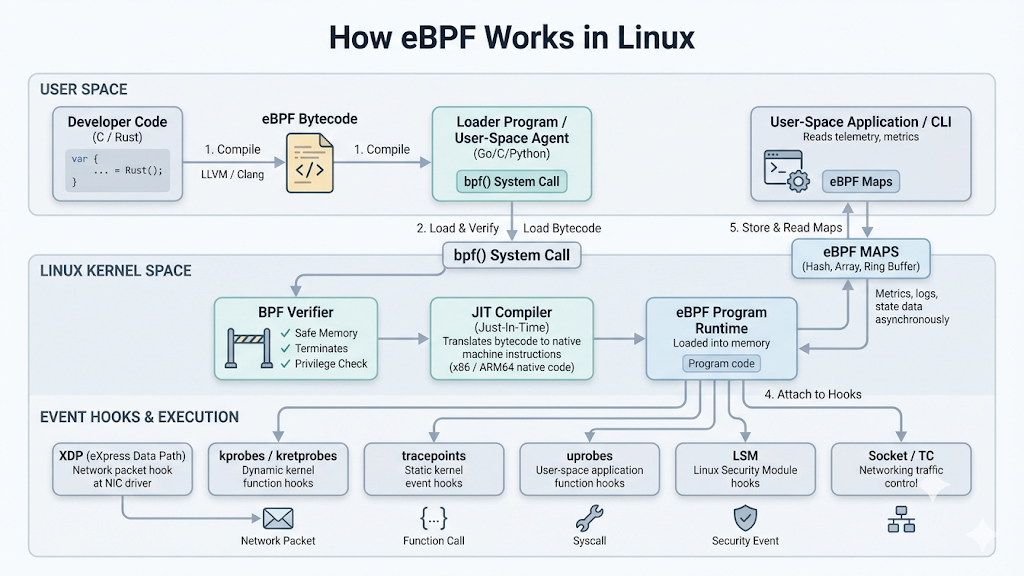
Here is the lifecycle of an eBPF program from code to execution:
- Write and Compile to Bytecode: we as devs write our logic in a restricted subset of C (or Rust), and compile it using LLVM/Clang into eBPF bytecode - a universal, architecture-independent instruction set.
- Load via the
bpf()Syscall: A user-space loader program (using libraries likelibbpf, Cilium'sebpf-go, or Python'sBCC) passes this bytecode into the kernel using thebpf()system call. - The eBPF Verifier (The Safety Gatekeeper): Before the kernel accepts a single instruction, the Verifier performs static analysis on the entire program. It walks every possible execution path to guarantee that:
- The program will always terminate (no unbounded loops that could hang the CPU).
- It never dereferences invalid pointers or reads out-of-bounds kernel memory.
- It does not exceed stack limits (512 bytes) or maximum instruction counts. If any check fails, the kernel flatly rejects the program.
- JIT Compilation: Once verified, the Just-In-Time (JIT) compiler translates the generic eBPF bytecode into native machine instructions (x86_64, ARM64, etc.). This ensures eBPF runs at near-native kernel speed, with virtually zero interpretation overhead.
- Attach to a Hook: The compiled program is attached to a specific kernel hook which is an event-driven insertion point inside the kernel execution path. When the kernel encounters a hook, it pauses its normal execution briefly, runs our attached eBPF program, and then resumes.
- Communicate via eBPF Maps: Because eBPF programs are stateless between invocations, they store state and share data with user space using eBPF Maps. eBPF Maps are efficient key-value data structures (hash tables, ring buffers, LRU caches) residing in kernel memory that both the eBPF program and user-space applications can read and write concurrently.
So this was the basic explaination about eBPF, if u want to explore more, u can visit their website (https://ebpf.io/).
If you liked the explaination, please leave a comment. Follow for more !!
About the author
- Myself Om, A Cyber security engineer who just love diving deep into technical aspecrs of things, I like to learn and explore about OSes, Cyber Security, Networking and Software architectures and how they work.
Comments
Join the discussionNo comments yet. Be the first to comment.